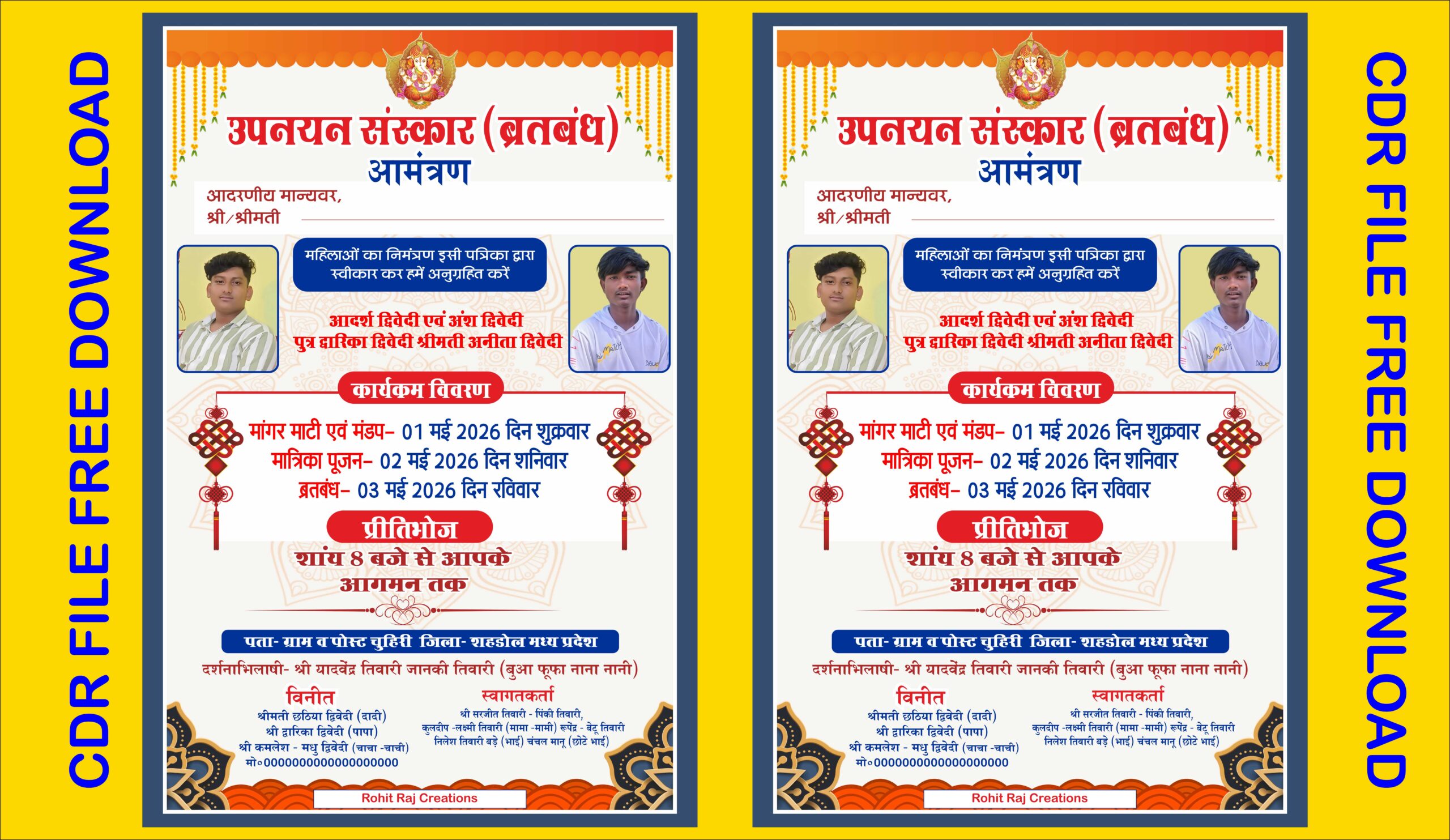
Upnayan Sanskar Card Design
ChatGPT, developed by OpenAI, is a sophisticated Artificial Intelligence (AI) system designed to understand and generate human-like text. Since its public debut in late 2022, it has evolved from a simple text-based chatbot into a multimodal “multitool” capable of seeing, hearing, and reasoning across a vast range of subjects.
How It Works: The Technology
At its core, ChatGPT is built on Large Language Models (LLMs). The “GPT” stands for Generative Pre-trained Transformer.
Generative: It can create new content rather than just searching for existing information.
Pre-trained: It has been trained on massive datasets—billions of words from books, websites, and articles—to learn the patterns of human language.
Transformer: This refers to the neural network architecture that allows the model to understand the relationship between words in a sentence, even when they are far apart.
The system works through tokenization, where it breaks down text into small chunks called “tokens.” Based on its training, it predicts the next most likely token in a sequence, similar to a highly advanced version of autocomplete. It is further refined through Reinforcement Learning from Human Feedback (RLHF), where human trainers rank its responses to ensure they are helpful, safe, and conversational.
Key Features and Capabilities
As of 2026, ChatGPT has expanded far beyond simple Q&A. Its current capabilities include:
Multimodal Interaction: Users can upload images for analysis, engage in real-time voice conversations with natural emotional range, and even share their screens for live troubleshooting.
Advanced Reasoning: Using models like GPT-5.4 Thinking, the AI can “think” before it speaks, creating internal plans for complex math, coding, or logical problems to ensure higher accuracy.
Specialized Tools: Features like Codex allow it to write and debug professional-grade code, while Prism provides a dedicated workspace for structured research and long-form writing.
Web Connectivity: It can search the internet in real-time to provide up-to-date news, local recommendations, and cited sources.
Impact and Ethical Considerations
ChatGPT has transformed several industries. In education, it acts as a personalized tutor; in business, it automates administrative tasks and data analysis; and in creative fields, it serves as a brainstorming partner.
However, its rise also brings challenges. Issues such as hallucinations (where the AI confidently states false information), potential bias in its training data, and concerns over academic integrity remain central to the conversation. To combat this, OpenAI has implemented strict safety protocols and “Under-18 Principles” to ensure age-appropriate interactions.
Conclusion
ChatGPT represents a shift in how humans interact with technology. It is no longer just a search tool but a collaborative partner. Whether you are using it to design a logo in CorelDRAW, debug a script, or summarize a 50-page report, it has become a central fixture in the modern digital toolkit, continuously adapting to the way we work and communicate.